AI-Driven Research Uncovers Quartet of Linux Kernel Privilege Escalation Flaws

A security researcher has publicly released working exploit code for four critical Linux kernel vulnerabilities that allow local users to achieve root-level access, prompting an urgent call for system administrators to verify their patch status. The vulnerabilities, collectively dubbed the "LPE Quartet," were discovered by researcher Asim Manizada, who reported the findings to the Linux kernel security team in mid-July. Following a coordinated disclosure period that allowed major Linux distributions to prepare and distribute necessary patches, the technical details and exploit proof-of-concepts were released to the public on September 18.
While there are currently no verified reports of these vulnerabilities being weaponized in malicious campaigns, the public availability of exploit code significantly lowers the barrier for entry for threat actors targeting multi-user environments or containerized infrastructure. Because these flaws target the core memory-management logic of the Linux networking stack, the potential for unauthorized privilege escalation is high on unpatched systems.
A Chronology of Discovery and Disclosure
The discovery of these vulnerabilities represents a significant milestone in the ongoing effort to harden the Linux kernel against memory-safety issues. Asim Manizada, who has previously contributed to the security community with other disclosures such as the OVSwrap flaw, identified the bugs using an AI-assisted analysis framework designed to map kernel memory handling.
The discovery process, which Manizada detailed in a technical write-up, began earlier this summer. Upon identifying the flaws, the researcher followed standard responsible disclosure protocols, notifying the Linux kernel maintainers in mid-July. This allowed the upstream development team to implement fixes across the affected subsystems, including IPsec AH6, TUN/TAP virtual network devices, PPPoE, and the SCTP networking module.
The coordinated effort ensured that by the time the research was published on September 18, enterprise distributions—such as Debian, Red Hat Enterprise Linux (RHEL), Ubuntu, and SUSE—had the opportunity to integrate these fixes into their respective security repositories. This delay between discovery and public disclosure is a critical component of the cybersecurity ecosystem, preventing "zero-day" scenarios where attackers can exploit flaws before defenders have the tools to mitigate them.
Technical Breakdown of the LPE Quartet
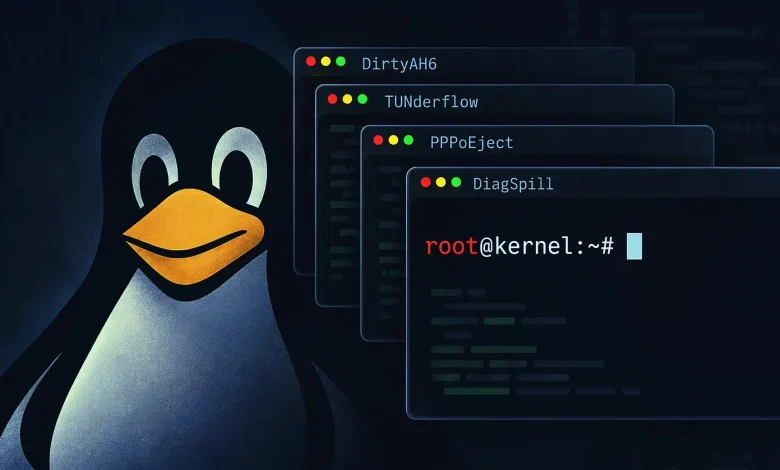
The vulnerabilities affect distinct, yet critical, areas of the Linux kernel’s networking stack. The following table provides a summary of the four flaws:

| Flaw Name | CVE Identifier | Affected Subsystem | Primary Prerequisite |
|---|---|---|---|
| DirtyAH6 | CVE-2026-80844 | IPsec AH6 (IPv6) | Unprivileged user namespaces |
| TUNderflow | CVE-2026-81000 | TUN/TAP virtual network devices | Unprivileged user namespaces |
| PPPoEject | CVE-2026-68121 | PPPoE | Unprivileged user namespaces |
| DiagSpill | CVE-2026-74469 | SCTP (sctp_diag) | None |
The technical commonality across these bugs is that they are all rooted in memory-safety errors. Specifically, these flaws involve improper handling of memory structures within the kernel, allowing a local user to corrupt memory buffers. By precisely manipulating these corruptions, an attacker can overwrite critical kernel data structures, ultimately redirecting kernel execution flow to gain a root shell.
Three of the four flaws—DirtyAH6, TUNderflow, and PPPoEject—rely on the existence of unprivileged user namespaces. User namespaces are a Linux kernel feature that permits an unprivileged user to create a virtual, sandboxed environment where they appear to be a root user. While this feature is essential for modern containerization technologies like Docker and Kubernetes, it has historically been a significant attack surface for local privilege escalation (LPE). The fourth flaw, DiagSpill, is notably more dangerous because it does not require user namespaces, making it exploitable on a wider variety of system configurations, provided the SCTP module is loaded.
Remote Execution Potential and Limitations
While the primary threat posed by these vulnerabilities is local privilege escalation, Manizada’s research explored the theoretical possibilities of remote exploitation. Two of the flaws, DirtyAH6 and DiagSpill, showed potential for network-based triggering, though the researcher noted significant limitations.
In the case of DirtyAH6, the flaw could theoretically be triggered remotely if the target machine is acting as an IPv6 router and utilizes specific IPsec Authentication Headers. However, the researcher emphasized that achieving a "remote root" outcome via this path would require an extreme level of precision, involving complex memory shaping on the target host, which is generally considered infeasible in real-world scenarios.
Similarly, DiagSpill could trigger a system crash if specific, non-default SCTP options are enabled. However, Manizada concluded that there is no identifiable path to achieve code execution or root escalation remotely through this method. The primary risk remains concentrated on users with existing, low-privileged access to a system, such as a compromised user account on a shared server, who then seek to escalate their privileges to bypass security controls.
The Rise of AI in Kernel Vulnerability Research
A notable aspect of this disclosure is the role of artificial intelligence in uncovering long-standing bugs. The flaws identified by Manizada range in age from 10 to 21 years old, meaning they have been dormant in the Linux kernel codebase for over a decade. The fact that these bugs were discovered through an AI-assisted process that maps kernel memory layout underscores a shift in how security research is conducted.
Modern kernels are millions of lines of code, making manual auditing increasingly difficult. AI models, when trained on the architecture of kernel memory, can identify patterns of unsafe memory access that human auditors might overlook. This approach has gained traction throughout 2026, with several high-profile vulnerabilities in various open-source projects being attributed to AI-augmented fuzzing and analysis tools.

The integration of AI into vulnerability research is a double-edged sword. While it enables researchers to proactively find and fix bugs before they are exploited by malicious actors, it also creates a feedback loop where the same technology can be utilized by sophisticated threat actors to automate the discovery of new vulnerabilities.
Mitigation and Institutional Response
For system administrators and DevOps engineers, the directive is clear: update to the latest stable kernel versions provided by their respective distributions. Because the Linux kernel maintainers have already merged the patches, the burden of security falls on the downstream distribution maintainers and the end-users who manage the servers.
If an immediate kernel update is not possible due to system stability requirements or testing constraints, administrators should consider the following temporary mitigations:
- Disable Unprivileged User Namespaces: For many systems, disabling unprivileged user namespaces can effectively block the exploitation of the three LPE flaws that rely on this feature. This can typically be achieved by setting
kernel.unprivileged_userns_clone = 0(or the equivalent sysctl parameter) in the system configuration. - Module Blacklisting: If the SCTP protocol is not required for the server’s function, blacklisting the
sctpkernel module can neutralize the DiagSpill vulnerability. - Network Perimeter Security: Since some of these vulnerabilities can be triggered via network packets, ensuring that ingress traffic is strictly filtered at the firewall level can reduce the exposure of internal kernel services to potentially malicious remote traffic.
Broader Implications for Security Infrastructure
The disclosure of the LPE Quartet highlights the persistent challenge of memory safety in C-based systems. Despite the ongoing efforts to transition to memory-safe languages like Rust within the Linux kernel, the vast majority of the kernel remains written in C, where memory-safety bugs are endemic.
The "LPE Quartet" also highlights the importance of shared infrastructure security. In cloud-native environments, where thousands of users may share the same physical hardware, a single kernel-level exploit can be catastrophic. The ability of an attacker to "escape" a container by exploiting a host kernel vulnerability remains one of the most critical threats in multi-tenant environments.
As the industry moves forward, the reliance on AI for bug discovery will likely become the standard. This necessitates a more robust and rapid response from the open-source community to ensure that when AI identifies a weakness, the community can verify and patch the issue with equal speed. Organizations are urged to audit their current infrastructure, prioritize patching of high-exposure servers, and maintain a vigilant posture against local privilege escalation risks. The era of AI-assisted vulnerability discovery is here, and the security of the global digital infrastructure depends on our ability to outpace the threats it identifies.
Related posts: